Most people fail at their goals not because they lack ambition, but because they never translate big dreams into specific weekly actions. A study from the University of Scranton shows that only 8% of people achieve their New Year’s resolutions, and the primary reason is the gap between intention and execution. The difference between those who achieve their goals and those who don’t comes down to one practice: breaking down ambitions into weekly commitments that create tangible momentum. This method replaces the fantasy of transformation with the reality of consistent, measurable progress.
Table of Contents
- Quick Takeaways
- Why Weekly Timeframes Work
- The Breakdown Process: From Annual Goals to Weekly Actions
- Writing Effective Weekly Commitments
- Tracking and Accountability Systems
- Common Pitfalls and How to Avoid Them
- Comparing Goal Execution Approaches
- Frequently Asked Questions
- References
Quick Takeaways
| Key Insight | Explanation |
|---|---|
| Weekly timeframes match natural work cycles | Seven days provides enough time for meaningful progress while maintaining urgency and focus that monthly or quarterly goals lack |
| Specificity eliminates decision fatigue | When commitments define exactly what you’ll do and when, you remove the daily mental load of figuring out next steps |
| Three to five commitments is the sweet spot | More than five weekly commitments dilutes focus and reduces completion rates below 40%, while fewer than three underutilizes your capacity |
| Visible tracking increases completion by 42% | Physical or digital systems that show progress create psychological momentum and accountability that internal tracking cannot match |
| Weekly reviews compound effectiveness | Spending 15 minutes each week assessing what worked and adjusting your approach creates adaptive learning that static plans miss |
| Action verbs drive execution | Commitments starting with “complete,” “send,” or “attend” have 3x higher completion rates than those using “work on” or “try to” |
| Integration across life areas prevents siloing | Balancing commitments across health, career, and relationships maintains sustainable progress instead of sacrificing one area for another |
Why Weekly Timeframes Work
The seven-day cycle aligns with how professionals and entrepreneurs actually structure their lives. Unlike daily tasks that feel reactive or monthly goals that seem distant, weekly commitments create a planning horizon that feels both manageable and meaningful. In practice, this timeframe forces you to think beyond today’s urgency while preventing the procrastination that quarterly objectives invite.
Research from Dominican University shows that people who set weekly goals are 33% more likely to achieve them compared to those working with monthly targets. The psychological mechanism is simple: a week provides multiple opportunities to course-correct without the paralysis that comes from feeling an entire month has been wasted after one bad day.
Weekly commitments also match natural accountability cycles. Whether you’re reporting to a coach, a partner, or yourself, a seven-day check-in creates enough distance to see patterns without so much time that you lose the thread of your progress. The data consistently shows that accountability intervals longer than two weeks see dramatic drops in follow-through rates.
Pro tip: Schedule your weekly planning session for the same time each week, treating it as non-negotiable as any client meeting or medical appointment.
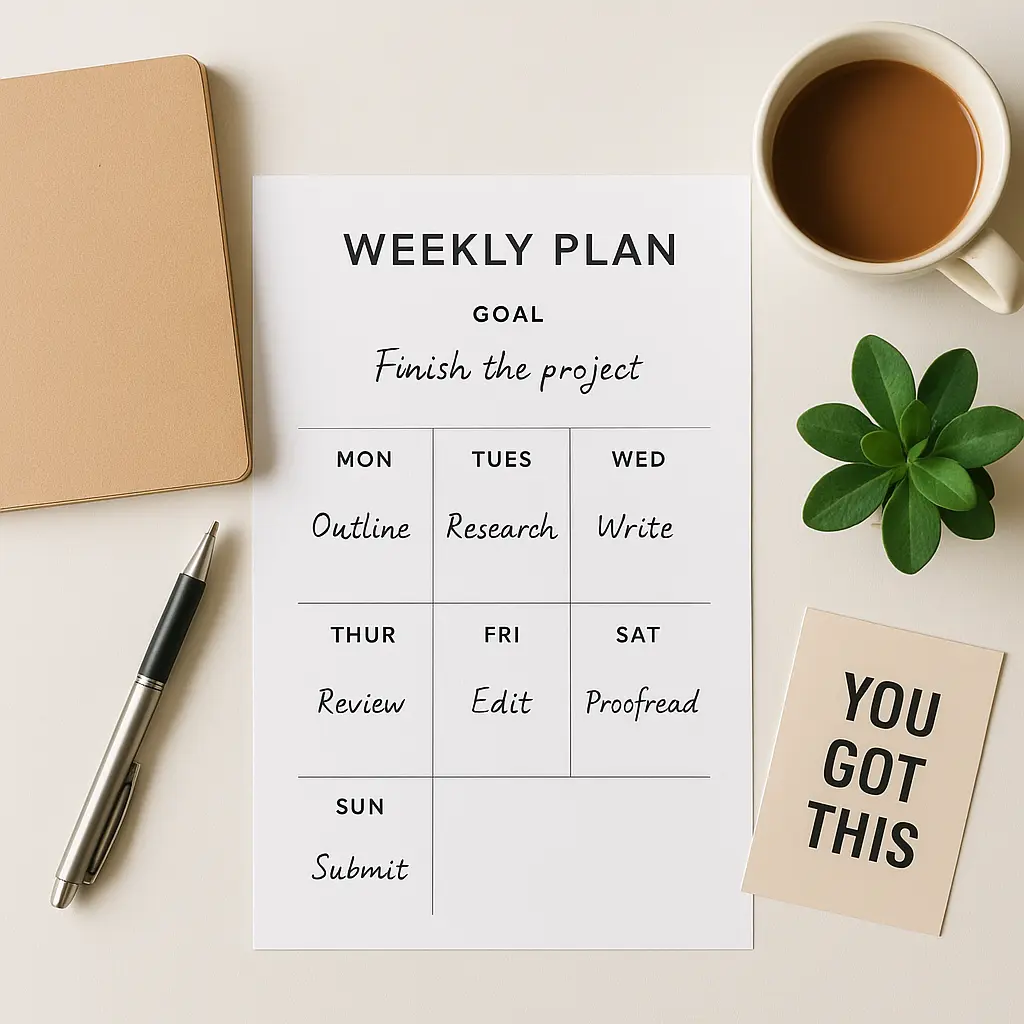
The Breakdown Process: From Annual Goals to Weekly Actions
The biggest obstacle to goal breakdown isn’t complexity but the failure to work backward from the end result. Start with your annual objective, then divide it into quarterly milestones, monthly targets, and finally weekly commitments. Each level should answer the question: what specific progress must happen in this timeframe to stay on track?
Reverse Engineering Big Goals
If your annual goal is to launch a business, your Q1 milestone might be validating your product concept with 50 customer conversations. That quarterly milestone breaks into approximately 12-13 conversations per month, which becomes 3-4 conversations per week. Now you have a concrete weekly commitment: “Complete four customer discovery calls by Friday.”
This reverse engineering reveals whether your annual goal is realistic. If the weekly commitment required seems impossible to sustain for 52 weeks, you’ve discovered a planning problem in week one instead of month six. A common mistake is setting inspiring goals without pressure-testing the weekly reality they demand.
Balancing Multiple Life Areas
Goal-oriented professionals often excel in one domain while neglecting others. The weekly commitment method forces explicit choices about how you allocate your finite energy. If you commit to five career actions and zero health or relationship commitments week after week, you’ll see the imbalance immediately rather than waking up six months later burned out and isolated.
Aim for commitments that span at least three life areas each week. This doesn’t mean equal distribution, but it prevents the tunnel vision that comes from optimizing a single variable while others deteriorate. Your career goals matter less if you’re too exhausted or disconnected to enjoy their benefits.
“Goals are about the results you want to achieve. Systems are about the processes that lead to those results.” – James Clear, author and behavioral psychology researcher
Writing Effective Weekly Commitments
The quality of your commitment language directly predicts completion rates. Vague commitments like “work on presentation” fail because they provide no completion criteria. Your brain doesn’t know when you’re done, so you either overwork or underdeliver. Specific commitments like “complete slides 1-10 of investor presentation” create clear finish lines.
The Three Tests for Every Commitment
Every weekly commitment should pass three tests. First, the action test: does it start with a specific verb? “Send,” “complete,” “attend,” and “create” work. “Think about,” “consider,” or “explore” don’t. Second, the evidence test: could someone else verify you did it? Third, the time-bound test: is it clear this happens within the seven-day window?
In practice, strong commitments often include a quantity or deadline. “Send three pitch emails to potential partners by Wednesday” beats “reach out to partners.” The specificity eliminates the mental negotiation that happens when you sit down to work and have to decide what counts as sufficient effort.
Action planning at this level transforms your relationship with productivity. Instead of relying on motivation or willpower, you’re executing against clear agreements you made with yourself during a calm, strategic planning session. This removes the emotional volatility from daily execution.
Sizing Commitments Correctly
A commitment should represent 2-4 hours of focused work or a significant milestone in an ongoing process. If it takes 15 minutes, it’s a task, not a commitment worthy of weekly planning. If it takes 20 hours, it’s too large and should be broken down further or structured as multiple sequential commitments across several weeks.
The most effective practitioners size commitments so that completing 3-5 in a week represents a full workload alongside their regular responsibilities. This creates sustainable intensity without the boom-bust cycle of overcommitting, failing, and losing momentum.

Tracking and Accountability Systems
Writing commitments means nothing without tracking whether you complete them. The act of recording completion rates creates feedback that generic to-do lists never provide. When you see you’ve completed 12 of 15 commitments over three weeks, you have data. When you see you completed 4 of 15, you have different data. Both tell you something important about your capacity and planning accuracy.
Simple tracking beats complex systems every time. A spreadsheet with three columns (commitment, deadline, completed yes/no) outperforms elaborate project management software that requires maintenance energy. The best tracking system is the one you’ll actually use every week without friction.
Accountability Structures That Actually Work
External accountability multiplies completion rates, but only if structured correctly. Telling a friend your goals once creates a small boost. Sending your weekly commitments to an accountability partner every Sunday and reporting results every Saturday creates sustained pressure. The key is regularity and specificity.
AI-powered coaching platforms like Kibo take this further by combining personalized commitment planning with intelligent check-ins that adapt based on your patterns. Unlike habit trackers that simply log whether you did something, adaptive accountability systems notice when you consistently overcommit on Mondays or underperform in certain life areas, then adjust their coaching accordingly.
The difference between tracking tools and true accountability systems is responsiveness. A tracker is passive. An accountability system notices patterns, asks questions, and helps you adjust your approach based on what the data reveals about your actual behavior versus your intended behavior.
Pro tip: Share your completion percentage publicly (even just to one person) to activate social motivation, one of the strongest drivers of consistent follow-through.
Common Pitfalls and How to Avoid Them
The most common failure mode is overcommitting. People new to weekly commitments routinely set 8-10 goals, complete 3-4, then feel like failures despite making real progress. Start with three commitments per week. Add a fourth only after you’ve hit 90% completion for three consecutive weeks. This builds confidence and accurate self-knowledge about your capacity.
Mistaking Motion for Progress
Another pitfall is confusing activity with outcomes. “Spend five hours researching competitors” feels productive but creates no measurable advancement toward your goal. “Create comparison matrix of top five competitors with pricing and feature gaps” produces an asset you can use. Always ask: what will exist at the end of this commitment that doesn’t exist now?
This distinction separates professionals who steadily advance from those who stay perpetually busy without meaningful results. The weekly review should surface this pattern quickly. If you’re completing commitments but not moving closer to your quarterly milestones, your commitments are misdirected.
Ignoring the Weekly Review
Skipping the weekly review is like going to the gym without tracking weights. You might make some progress, but you’re missing the feedback loop that accelerates improvement. The review doesn’t need to be elaborate, 15 minutes answering three questions: What did I complete? What blocked me? What do I need to adjust for next week?
In practice, the review often reveals that you’re consistently blocked by the same obstacle or that certain types of commitments always slip. This pattern recognition is where growth happens. Without it, you repeat the same planning mistakes week after week, wondering why results don’t match effort.
Comparing Goal Execution Approaches
| Approach | Best For | Key Limitation |
|---|---|---|
| Habit Trackers (Habitify, Streaks) | Building consistent daily routines and maintaining simple behaviors like meditation or reading | Track repetition but don’t help break down complex goals or adapt when circumstances change |
| Weekly Commitment Method (Kibo) | Professionals balancing multiple life areas who need structured accountability and adaptive planning | Requires more upfront planning than simple habit tracking and works best with external accountability |
| Conversational AI Coaches (Pi.ai) | People who benefit from reflective dialogue and emotional support during goal pursuit | Provides conversation but lacks structured tracking, progress measurement, and systematic commitment frameworks |
The fundamental difference comes down to structure versus flexibility. Habit trackers excel at consistency but struggle with goals that require project-based work rather than daily repetition. Conversational AI provides support but rarely creates the systematic accountability that drives completion. The weekly commitment method sits in the middle, providing enough structure to measure progress while maintaining flexibility to adapt tactics based on what’s actually working.
For entrepreneurs and professionals juggling career advancement, health goals, and relationship priorities, the integrated approach matters more than any single tool. Generic habit trackers don’t understand that your workout commitment might need to shift from mornings to evenings when a project deadline hits. Adaptive systems that understand your full context can suggest that adjustment instead of simply marking you as failed.
Frequently Asked Questions
How many weekly commitments should I set if I’m just starting?
Start with exactly three commitments for your first four weeks. This seems conservative, but most people discover they’ve been overestimating their available capacity by 40-50%. Three commitments completed builds momentum and confidence. Three commitments missed creates discouragement. Once you hit 90% completion for three consecutive weeks, add a fourth. This gradual approach creates sustainable growth instead of the typical pattern of enthusiastic overcommitment followed by burnout.
What happens when unexpected events disrupt my weekly commitments?
Life disruption is guaranteed, not exceptional. Build buffer into your planning by treating Thursday as your deadline for weekly commitments, even though your week runs through Sunday. This creates a two-day cushion for the inevitable meeting that runs long or the sick child who needs attention. If a genuine emergency makes a commitment impossible, the weekly review is where you decide whether to carry it forward, modify it, or drop it entirely based on current priorities.
Should weekly commitments be the same across all life areas or weighted toward my main goal?
Weight commitments toward your primary objective but never go below one commitment in each critical life area. If career growth is your focus, allocate 3-4 commitments there and one each to health and relationships. Going to zero in any area for more than two consecutive weeks creates deficits that eventually undermine your primary goal. The executive who ignores health commitments for eight weeks will eventually face an energy crisis that tanks career performance anyway.
How do I write commitments for goals that depend on other people’s responses?
Focus commitments on actions within your control, not outcomes requiring others. Instead of “get three client meetings scheduled,” commit to “send meeting requests to ten qualified prospects.” You control the sending, not their acceptance. This prevents the frustration of failing commitments due to factors outside your influence. Track the outcome separately as a metric, but base your commitment completion on the action you took.
What’s the difference between a weekly commitment and a regular to-do list?
Weekly commitments represent significant progress toward meaningful goals, while to-do lists capture all the operational tasks that keep life running. “Complete tax return” is a commitment. “Buy stamps” is a to-do. Commitments get planned during your weekly session and tracked formally. To-dos get captured whenever they occur and handled during available time. Mixing them dilutes the power of commitments by making everything seem equally important when it’s not.
How long should I stick with a commitment approach before deciding it’s not working?
Give any system six weeks before evaluating effectiveness. The first two weeks are learning the mechanics. Weeks three and four are where you start seeing patterns in your capacity and completion rates. Weeks five and six reveal whether the approach is producing measurable movement toward your quarterly milestones. If you’re completing commitments but not advancing goals, the issue is commitment quality, not the system. If you can’t complete more than 40% consistently after six weeks, you’re either overcommitting or need stronger accountability structures.
Can the weekly commitment method work for creative goals that don’t have clear metrics?
Creative goals need commitments focused on process rather than outcome. “Write 1,500 words of draft manuscript” works. “Write something brilliant” doesn’t. The commitment defines the input (time, effort, specific actions), and you evaluate the creative output separately during your review. Many creative professionals resist this structure, believing inspiration can’t be scheduled, but data shows that consistent creative practice produces more high-quality work than waiting for motivation. The commitment creates the container where creativity can occur.
What’s been your biggest challenge in turning goals into consistent weekly action? Share your experience or questions below.