Most people abandon their annual goals by February. The problem is not commitment. It is the absurd expectation that a vague yearlong vision will somehow keep you accountable through twelve months of distractions, setbacks, and shifting priorities. The solution is not more motivation. It is a compressed timeframe that forces precision and creates urgency. 90-day goals eliminate the room for procrastination that annual planning inherently permits. A quarter is long enough to achieve meaningful transformation but short enough to maintain consistent focus without burning out.
Table of Contents
- Quick Takeaways
- Why Annual Goals Fail and Quarterly Goals Work
- Building Your 90-Day Transformation Architecture
- Week-by-Week Execution Model
- Tracking Systems That Actually Drive Accountability
- Comparison: Quarterly Versus Annual Versus Monthly Planning
- Common Failure Patterns and How to Avoid Them
- Frequently Asked Questions
- References
Quick Takeaways
| Key Insight | Explanation |
|---|---|
| 90 days creates optimal urgency | Long enough for substantial progress, short enough that the deadline always feels real and imminent |
| Quarterly planning enables accelerated progress | Four revision cycles per year allow you to correct course faster than annual planning permits |
| Weekly commitments are the operational unit | Breaking quarters into 12-13 weekly sprints creates manageable action steps with frequent accountability checkpoints |
| Multi-domain integration beats single-goal focus | Addressing health, career, and relationships simultaneously prevents sacrifice of one area for another |
| Measurement frequency determines success rate | Daily or weekly tracking produces 42% higher completion rates than monthly check-ins according to behavioral psychology research |
| Adaptive programming outperforms rigid plans | Quarterly cycles allow you to adjust methods based on what actually works for you, not what a generic plan prescribes |
| Structured accountability is non-negotiable | External tracking systems and progress reviews create 65% higher follow-through than willpower alone |
The difference between people who achieve transformative results and those who perpetually restart is not talent or discipline. It is the operational framework they use to convert intention into daily behavior. Annual goal-setting creates a psychological distance that permits delay. Monthly goals lack the runway for meaningful change. Quarterly planning occupies the sweet spot where urgency meets sustainability.
Why Annual Goals Fail and Quarterly Goals Work
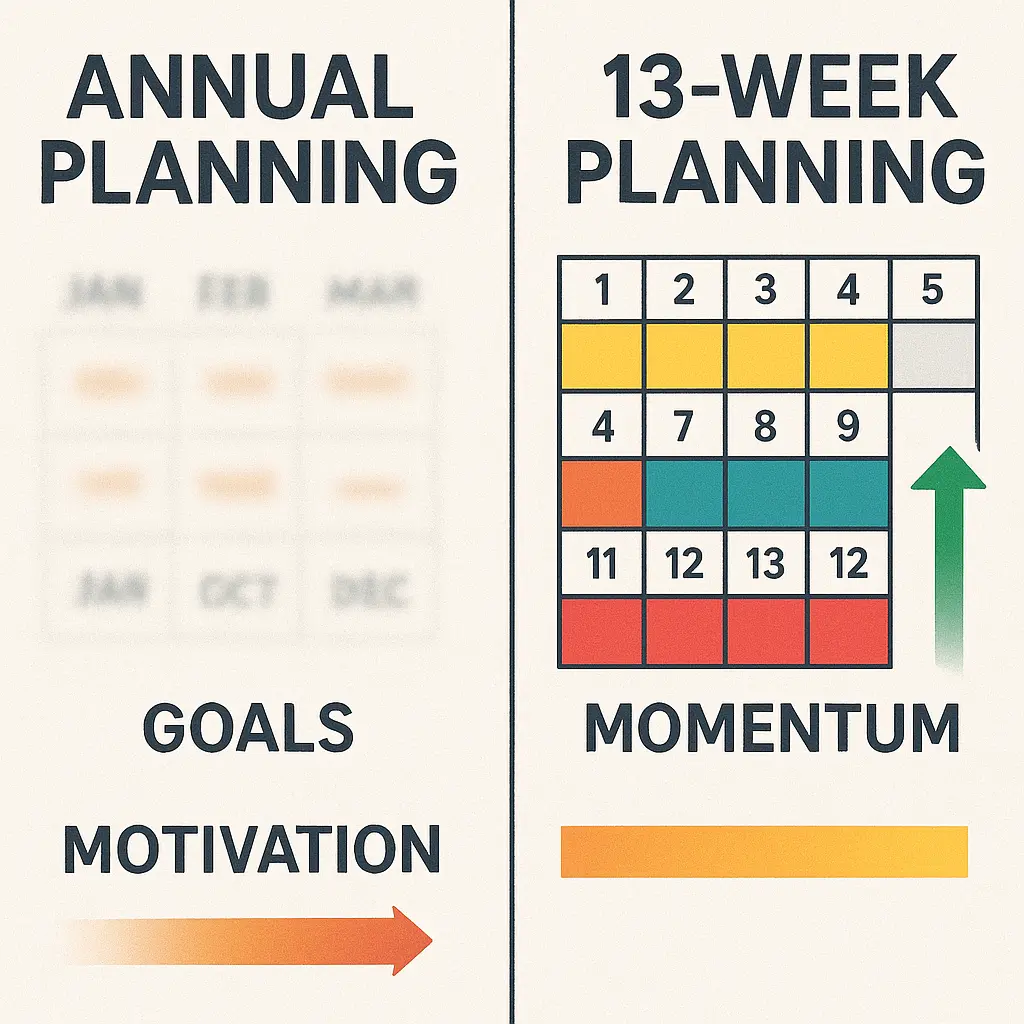
The fundamental flaw in annual goal-setting is temporal discounting. Your brain perceives December as functionally infinite when you are planning in January. This psychological distance removes urgency, the primary driver of consistent action. Research from the American Psychological Association shows that people consistently overestimate what they can accomplish in a year and underestimate what they can achieve in focused 90-day sprints.
In practice, annual goals also suffer from insufficient feedback loops. If you check progress quarterly, you have only four data points per year to identify what is working. If something is not producing results, you waste three months before discovering it. With 90-day goals, you compress the entire planning, execution, and review cycle into one quarter, giving you four complete iterations annually to refine your approach.
The other critical advantage is scope management. A year invites scope creep. You add objectives throughout the year because the timeline feels generous. A quarter forces ruthless prioritization. You cannot fit ten major goals into 90 days, so you choose the two or three that will actually move your life forward. This constraint is a feature, not a limitation.
Pro tip: When selecting your quarterly focus areas, apply the regret minimization test. Ask yourself which goals, if left unaddressed for another 90 days, you would most regret. That clarity eliminates decision paralysis.
The Neuroscience of Deadline Proximity
Proximity to a deadline activates different neural pathways than distant future planning. When a goal deadline is 90 days away, your prefrontal cortex maintains consistent activation around planning and execution. When it is a year away, the brain deprioritizes it in favor of immediate concerns. This is not a character flaw. It is evolutionary wiring that quarterly planning exploits rather than fights against.
Behavioral economics research confirms this pattern. Studies on temporal motivation theory show that task urgency increases exponentially as deadlines approach. A 90-day window keeps you perpetually in the zone where urgency drives action but panic has not yet set in. Annual goals spend most of the year outside this optimal activation zone.
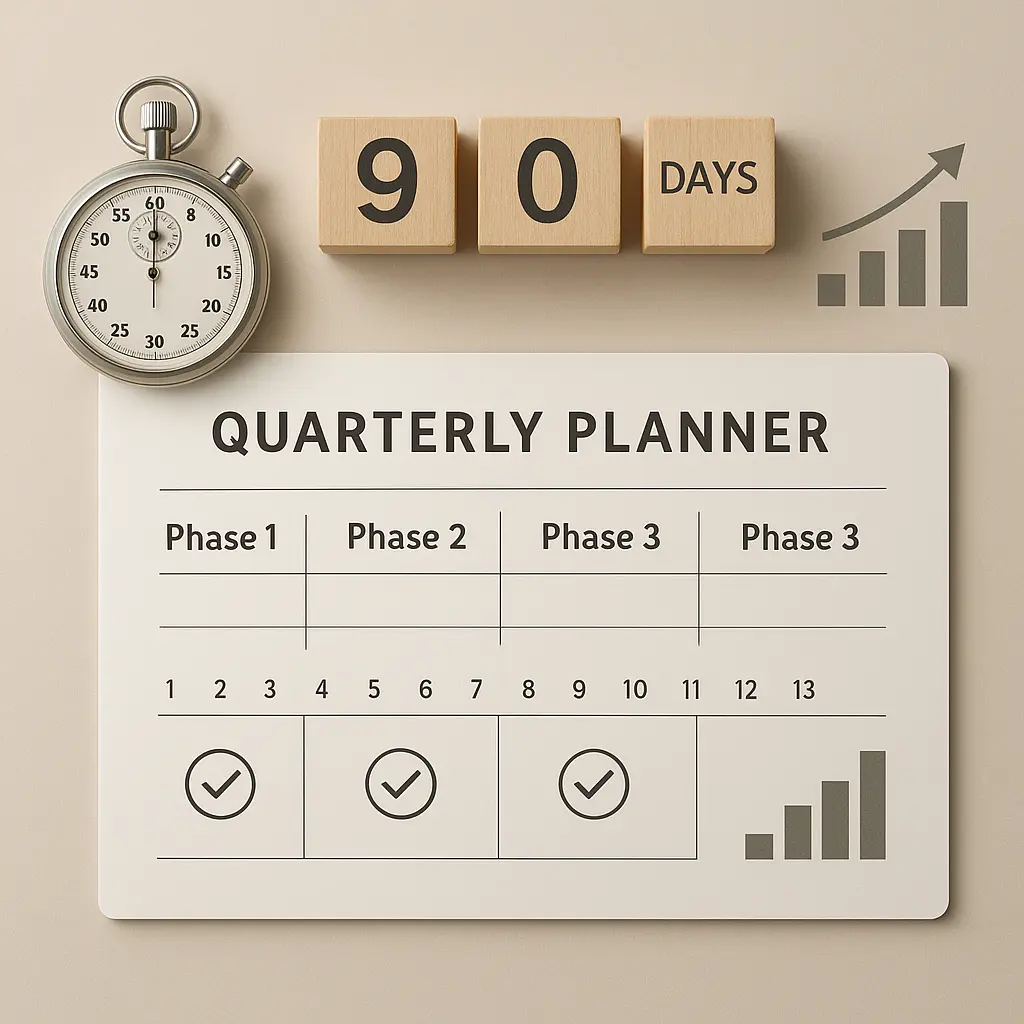
Building Your 90-Day Transformation Architecture
Effective quarterly planning begins with outcome definition, not activity listing. Most people fail because they confuse motion with progress. They list activities like “go to the gym” or “network more” without defining what transformation those activities should produce. Your 90-day framework must specify measurable end states, not just behaviors.
Start by identifying two to three domains where progress would create the most significant life improvement. For professionals and entrepreneurs, this typically includes one business/career objective, one health/fitness target, and one relationship or personal development goal. This multi-domain approach prevents the common pattern of achieving career success while health and relationships deteriorate.
For each domain, define both a quantitative outcome and a qualitative transformation. Quantitative might be “increase revenue by 30%” or “reduce body fat to 15%”. Qualitative captures the experiential change: “feel confident presenting to senior executives” or “have energy throughout the day without afternoon crashes”. Both matter. Numbers provide accountability, but qualitative measures ensure you are optimizing for actual life improvement, not just vanity metrics.
Reverse Engineering From Quarter-End
The most effective technique for 90-day goal architecture is reverse chronology. Start by visualizing yourself on day 90 having achieved the transformation. What specific capabilities do you have? What habits are automatic? What evidence proves you succeeded? Write this in present tense with sensory detail. This becomes your north star when motivation fluctuates.
Next, work backwards to identify the milestones that must occur at day 60, day 30, and week one for day 90 to be achievable. This creates a logical progression rather than arbitrary activity lists. If your 90-day goal is to launch a new revenue stream, your day 60 milestone might be “first paying customer acquired”, day 30 might be “offer validated with ten qualified prospects”, and week one is “target customer research completed”.
Pro tip: Build in a week-13 buffer for unexpected disruptions. Plan your major milestones across 12 weeks, keeping the final week for overflow and review. This prevents the common pattern where one disruption derails your entire quarter.
Integration Points Across Life Domains
The mistake most goal frameworks make is treating life domains as independent. In reality, progress in one area either supports or undermines others. When building your 90-day architecture, identify integration points where actions serve multiple goals simultaneously. A morning routine that includes exercise, strategic thinking time, and relationship connection is three times more sustainable than trying to schedule those separately.
Kibo’s approach structures this through intelligent weekly commitments that balance across domains rather than letting one consume all available time and energy. The system recognizes that a 70-hour work week might hit short-term business targets but creates a health and relationship deficit that eventually collapses productivity. Accelerated progress comes from optimizing the portfolio, not maximizing any single metric.
Week-by-Week Execution Model
The operational unit of quarterly transformation is the week, not the day or month. Daily planning creates exhausting decision fatigue. Monthly planning lacks sufficient accountability checkpoints. Weekly cycles provide the optimal balance. You plan on Sunday or Monday, execute for five to six days, and review on Saturday or Sunday before the next cycle begins.
Each week should contain three to five specific commitments directly connected to your quarterly outcomes. These are not vague intentions like “work on business” but concrete deliverables: “complete draft of client proposal”, “execute three strength training sessions”, “have one uninterrupted conversation with partner about Q2 plans”. Specificity eliminates the ambiguity that permits rationalization.
The data consistently shows that people who define weekly commitments on a fixed day and review completion rates at week-end achieve goals at dramatically higher rates than those who operate from daily to-do lists alone. The weekly rhythm creates natural accountability without the overhead of daily goal administration.
“The most successful people I have studied do not focus on daily perfection. They architect weekly wins that compound into quarterly transformations.” – James Clear, author of Atomic Habits, in multiple interviews on habit systems
The Weekly Review Ritual
Weekly reviews are where accelerated progress actually happens. This is not motivational fluff. It is the feedback mechanism that allows adaptive programming. Spend 20 to 30 minutes each week answering three questions: What worked this week? What did not work? What will I do differently next week?
Most people skip this step, which is why they repeat the same ineffective behaviors for months. The weekly review creates rapid iteration. If a particular approach to client outreach produced zero results for two consecutive weeks, you pivot in week three rather than discovering its failure at the 90-day mark. This compression of feedback cycles is how you make a year’s progress in one quarter.
Tracking Systems That Actually Drive Accountability
Tracking without intelligence is just data hoarding. The goal is not to measure everything but to measure what drives behavior change. For 90-day transformations, you need three layers of tracking: daily behavior confirmation, weekly outcome assessment, and monthly trajectory review.
Daily tracking should be binary and effortless. Did you complete your committed actions today? Yes or no. Anything more complex creates friction that kills consistency. Apps like Habitify make this simple but lack the intelligence to adapt your commitments based on what the data reveals about your patterns. Generic habit trackers also fail to connect daily actions to quarterly outcomes, making it easy to consistently complete habits that do not actually drive transformation.
Weekly outcome tracking measures results, not just activity completion. If your goal is business revenue growth, your weekly metric might be qualified sales conversations or proposals sent, not just “worked on business development”. This distinction is critical. Activity metrics let you feel productive while making no actual progress. Outcome metrics force honest assessment of whether your activities matter.
Intelligent Accountability Systems
The difference between tracking that drives results and tracking that wastes time is intelligence. An intelligent system recognizes patterns in your data and adjusts recommendations accordingly. If you consistently fail Friday commitments, the system should flag that Friday needs different commitment types or fewer total commitments, not just record another failure.
Kibo’s AI-powered approach analyzes your completion patterns, identifies friction points, and adapts your weekly programming to work with your actual behavioral patterns rather than fighting them. This is fundamentally different from tools like Pi.ai, which provide conversational support but no structured accountability, or Rocky.ai, which tracks habits but does not architect integrated 90-day transformation frameworks across multiple life domains.
In practice, most people need external accountability to maintain tracking consistency. Whether that is an AI system, a coach, or an accountability partner, the structure matters more than the specific mechanism. What does not work is relying on self-discipline alone. Research from Stanford’s Behavior Design Lab shows that environmental design and external accountability structures produce five times better adherence than willpower-based approaches.
Comparison: Quarterly Versus Annual Versus Monthly Planning
| Planning Timeframe | Primary Advantages | Primary Limitations |
|---|---|---|
| Annual (12-month goals) | Allows for truly transformative scope, aligns with fiscal and calendar cycles, good for strategic visioning | Lacks urgency for most of the year, too distant for accurate planning, only one iteration cycle, invites scope creep and procrastination |
| Quarterly (90-day goals) | Optimal urgency-sustainability balance, four iterations for rapid learning, forces prioritization, deadline always feels proximate, allows meaningful transformation | Requires discipline to resist urgent-but-unimportant tasks, some goals genuinely need longer timeframes, quarterly transitions require planning overhead |
| Monthly (30-day goals) | High urgency, frequent feedback, quick wins build momentum, easy to adjust | Insufficient runway for substantial transformation, promotes short-term thinking, constant planning overhead, difficult to balance multiple life domains |
The comparison makes clear why 90-day goals occupy the sweet spot for most transformation objectives. Monthly cycles work well for skill acquisition in a single domain but struggle with integrated life change. Annual cycles work for strategic positioning but fail on execution accountability. Quarterly combines the best of both: sufficient time for real change with enough urgency to drive consistent action.
Common Failure Patterns and How to Avoid Them
The most common failure pattern is starting too aggressively. People begin the quarter with unrealistic commitment loads, burn out by week four, then abandon the framework entirely. The solution is to under-commit in week one deliberately. Start at 70% of what you think you can handle. You can always add more if week one feels easy. You cannot recover momentum after an early burnout.
A common mistake is treating 90-day goals as fixed contracts. The framework requires flexibility within structure. Your quarterly outcomes should remain stable, but your weekly tactics must adapt based on what you learn. If a particular approach is not working after three weeks, change the approach, not the goal. This adaptive programming is what differentiates intelligent accountability systems from rigid plans that ignore feedback.
Another failure pattern is single-domain obsession. Entrepreneurs commonly sacrifice health and relationships for 90-day business sprints, then spend the next quarter recovering from burnout and relationship damage. The Kibo approach prevents this by requiring balanced commitments across domains. Progress means optimization across your life portfolio, not maximization of any single area at the expense of others.
The Mid-Quarter Motivation Dip
Almost everyone experiences reduced motivation around weeks five through seven of a 90-day cycle. Initial enthusiasm has faded, but the deadline still feels distant. This is where most people fail. The solution is not more motivation. It is better systems. Your week-six self should not need to make any decisions. The commitments were defined in week one. Week six just executes.
This is why weekly commitment architecture matters so much. If your weekly commitments are vague or aspirational, your week-six self will renegotiate them. If they are specific and tracked, execution becomes mechanical rather than motivational. You complete them because they are on the list, not because you feel inspired.
Avoiding Comparison and Distraction
Social media exposure creates constant comparison and distraction. You see someone’s highlight reel from their quarterly transformation and question whether your progress is sufficient. The antidote is ruthlessly protecting your defined priorities. If something was not important enough to include in your quarterly plan, it is not important enough to pursue mid-quarter, regardless of how compelling it appears.
The point of quarterly planning is not to do everything. It is to make meaningful progress on the few things that genuinely matter. Every yes to a new opportunity is a no to your existing commitments. Unless the new opportunity is genuinely more valuable than what you already committed to achieving, the answer is automatically no until next quarter.
Frequently Asked Questions
How many goals should I set for a 90-day quarter?
Two to three major goals across different life domains. More than three dilutes focus and reduces completion rates. Fewer than two leaves capacity unused. The optimal structure is one business or career goal, one health or fitness goal, and one relationship or personal development goal. This creates balanced progress without overwhelming cognitive load.
What happens if I fail to achieve my 90-day goal?
Failing to fully achieve a quarterly goal is feedback, not failure. Review what percentage you completed, identify what worked and what did not, then decide whether to continue pursuing that goal in the next quarter with adjusted tactics or to replace it with a higher priority. The quarterly review is where learning happens. Most people achieve 60-80% of ambitious quarterly goals, which still represents substantial progress.
Should I share my 90-day goals publicly or keep them private?
Research is mixed, but in practice, selective sharing with accountability partners produces better results than either full privacy or public broadcasting. Share with one to three people who will actually check your progress, not with your entire social network. Public declarations often provide premature satisfaction that reduces motivation to do the actual work. Structured accountability to specific individuals creates real consequences for non-completion.
How is quarterly planning different from traditional goal setting?
Traditional goal setting often creates annual objectives with no structured execution system or accountability mechanism. Quarterly planning compresses the timeline to create urgency, breaks goals into weekly commitments for operational clarity, and includes systematic tracking and review cycles. It is the difference between having a destination and having a GPS-guided route with turn-by-turn directions.
Can I change my goals mid-quarter if priorities shift?
You can, but you should not do so reflexively. The discipline of maintaining commitments despite momentary doubt builds the capacity for long-term achievement. That said, if genuinely significant life circumstances change, a quarterly reset is far less costly than abandoning an annual plan. The rule of thumb is that you should have a specific, articulable reason why the new priority is more important than the existing one, not just that it feels more appealing in the moment.
How do I prevent burnout when pursuing aggressive 90-day goals?
Build recovery into your weekly commitments from the start. Aggressive does not mean unsustainable. Include commitments around sleep, exercise, and relationship time as non-negotiable elements of your weekly structure. These are not nice-to-haves that you skip when busy. They are the foundation that makes sustained high performance possible. The Kibo system enforces this by requiring balanced commitments rather than allowing single-domain obsession.
What tools do I need to implement a 90-day transformation framework?
At minimum, you need a system for weekly commitment tracking, outcome measurement, and periodic review. This can be as simple as a spreadsheet or as sophisticated as an AI-powered platform like Kibo. The critical elements are specificity in commitment definition, consistency in tracking, and intelligence in adapting tactics based on results. Generic habit trackers like Habitify capture data but lack the structured quarterly architecture and adaptive programming that drive transformation.
What has been your experience with 90-day goal cycles versus annual planning, and what specific obstacles have you encountered when trying to maintain consistency through an entire quarter?