Most people fail at their goals not because they lack motivation, but because they lack a functional accountability system. Research from the American Society of Training and Development shows that having a specific accountability appointment increases your chance of completing a goal by up to 95%. Yet most goal-setters rely on willpower alone or ineffective habit trackers that measure streaks without measuring actual progress toward meaningful outcomes. A proper accountability system transforms vague intentions into measurable commitments with built-in feedback loops.
Table of Contents
- Quick Takeaways
- What Makes Accountability Systems Fail
- The Three Pillars of Functional Accountability
- Designing Your Commitment Architecture
- Progress Tracking That Drives Behavior Change
- Self-Management Strategies for Sustained Performance
- Choosing the Right Accountability Tools
- Frequently Asked Questions
- References
Quick Takeaways
| Key Insight | Explanation |
|---|---|
| Specificity beats motivation | Systems with concrete weekly commitments outperform vague daily habits by creating clear success criteria you can measure and adjust |
| External accountability multiplies results | People with accountability partners or coaching are 65% more likely to achieve goals than those tracking privately |
| Outcome tracking trumps activity tracking | Measuring results (weight lost, revenue earned, skills acquired) drives better decisions than counting streaks or check-ins |
| Weekly cycles create optimal feedback | Daily tracking creates noise and anxiety, monthly reviews miss correction opportunities, but weekly reviews balance both |
| Adaptive systems beat rigid ones | Accountability systems that adjust commitments based on actual capacity and progress prevent burnout and sustain long-term performance |
| Structure precedes willpower | Well-designed commitment architecture removes decision fatigue and makes follow-through the path of least resistance |
| Multi-domain balance requires active management | Professionals juggling health, career, and relationships need integrated accountability systems, not separate trackers for each area |
What Makes Accountability Systems Fail
The accountability graveyard is filled with abandoned habit trackers, forgotten New Year’s resolutions, and unused accountability partners. The common thread? Systems built on flawed assumptions about human behavior.
Most people confuse accountability with punishment. They design systems that shame them for missed days or broken streaks. This creates avoidance behavior where you stop checking the system entirely rather than face the evidence of your failures. Effective accountability systems focus on learning and adjustment, not judgment.
Another fatal flaw is tracking inputs without connecting them to outcomes. You might religiously log that you exercised five days this week, but if your actual goal is to run a marathon and you’re not getting faster or building endurance, the system is measuring the wrong thing. Progress tracking must tie directly to the results you want, not just the activities you think will get you there.
The Streak Trap
Habit tracking apps like Habitify built their entire model around maintaining streaks. The psychology is simple: you don’t want to break a 47-day streak, so you do the minimum required action. In practice, this creates brittle systems that collapse the moment life interferes.
A common mistake is designing accountability around daily check-ins. This frequency generates too much data to act on meaningfully and turns your system into a chore rather than a tool. Daily tracking works for process metrics in controlled environments, but for personal goals across multiple life domains, it creates cognitive overload.
Pro tip: If your accountability system makes you feel worse about yourself after using it, the system is broken, not you. Redesign it to highlight progress and identify obstacles, not to catalog failures.
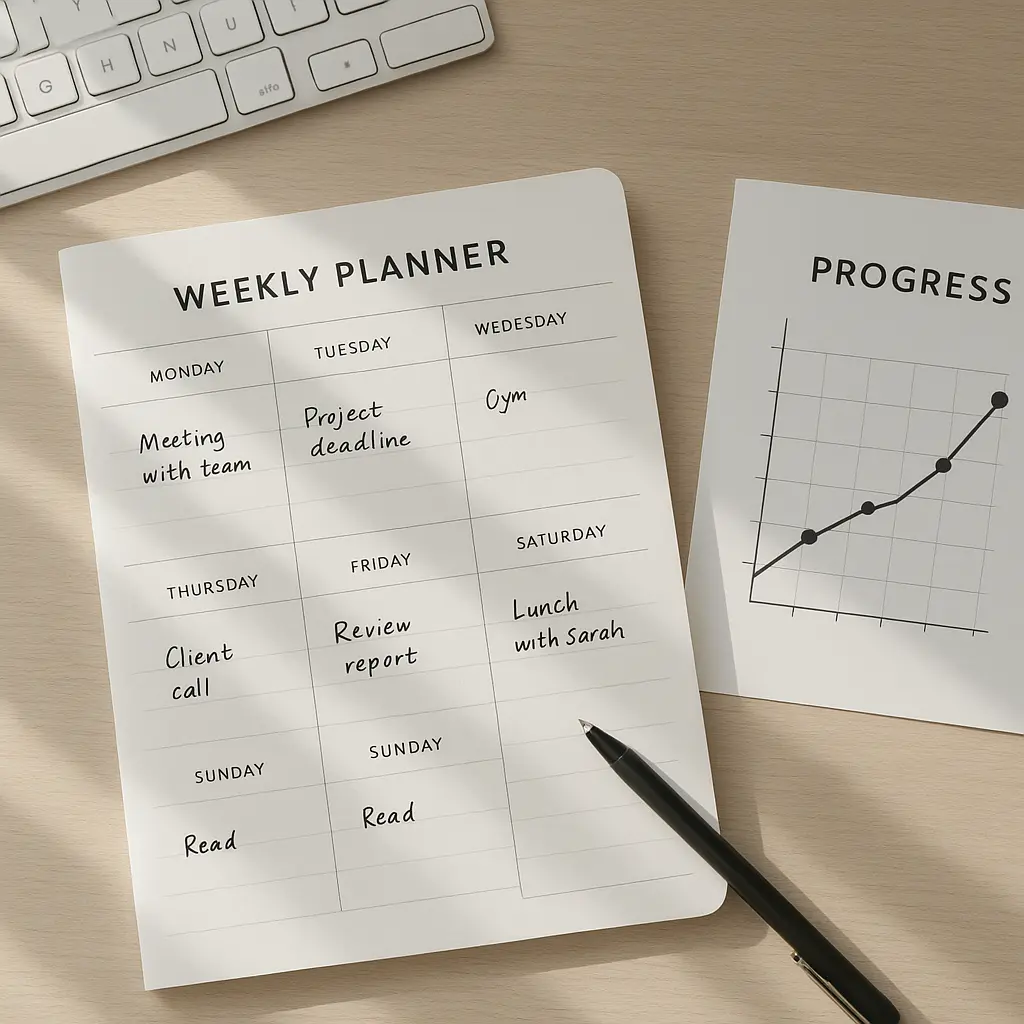
The Three Pillars of Functional Accountability
Every accountability system that actually works rests on three foundational elements: clarity of commitment, structured feedback loops, and external validation. Remove any one of these and the system degrades into a wishful thinking exercise.
Clarity of Commitment
Vague goals create vague results. “Get healthier” is not a commitment, it’s a direction. “Complete three 30-minute strength training sessions per week for the next 8 weeks” is a commitment with built-in success criteria.
The data consistently shows that goals framed as specific weekly commitments have completion rates 3-4 times higher than identical goals framed as daily habits or long-term aspirations. Weekly framing provides enough flexibility to accommodate reality while maintaining meaningful structure.
Structured Feedback Loops
Your accountability system must answer two questions every week: What happened? What needs to change? Without regular review cycles, you’re collecting data but not learning from it.
The optimal review frequency for most people is weekly. This interval is short enough to catch problems before they compound but long enough to see meaningful patterns. Monthly reviews miss too many correction opportunities. Daily reviews create reactive thinking instead of strategic adjustment.
External Validation
Self-reported progress without external accountability is the easiest thing to rationalize away. You can always explain to yourself why this week was an exception, why the circumstances were unusual, why you’ll definitely do better next week.
Research published in the Journal of Consulting and Clinical Psychology found that participants with weekly accountability check-ins lost significantly more weight than those tracking privately, even when both groups followed identical nutrition and exercise protocols. The mere act of reporting to someone else changes behavior.
Designing Your Commitment Architecture
The structure of your commitments determines whether your accountability system reinforces good decisions or requires constant willpower to maintain. Well-designed commitment architecture makes follow-through easier than avoidance.
Start by translating each major goal into 2-3 specific weekly commitments. If your goal is career advancement, a weekly commitment might be “complete one substantive networking conversation and draft one thought leadership article.” This is concrete, measurable, and achievable within a weekly cycle.
Avoid the trap of commitment overload. Most people can realistically maintain 5-7 weekly commitments across all life domains. Beyond that, you’re setting yourself up for systematic failure. It’s better to have three commitments you actually complete than ten you perpetually miss.
The Capacity Calibration Process
Your first month with any new accountability system should focus on calibration, not achievement. You’re learning your actual capacity, not your aspirational capacity.
Set initial commitments at 60-70% of what you think you can handle. Track completion rates weekly. If you’re hitting 90%+ consistently for three weeks, increase commitment difficulty by 15-20%. If you’re below 70%, reduce commitment scope immediately. This adaptive approach prevents both boredom and burnout.
Pro tip: Schedule your commitments as calendar blocks with the same rigor you’d apply to client meetings. Unscheduled commitments are wishes, not plans.
“What gets measured gets managed, but what gets scheduled gets done. The difference between successful and unsuccessful people isn’t intention, it’s infrastructure.” – Behavioral economics research from Duke University shows that pre-commitment devices increase follow-through rates by up to 40%.
Progress Tracking That Drives Behavior Change
Most progress tracking focuses on lagging indicators: what you’ve already done. Effective tracking balances lagging indicators with leading indicators: the behaviors that predict future success.
For a career goal, a lagging indicator might be “received promotion.” Leading indicators would be “completed certification course,” “presented at team meeting,” or “shipped visible project.” You can’t directly control the promotion, but you can control the behaviors that make it likely.
Track both completion (did I do the committed action?) and effectiveness (did it produce the intended result?). You might complete all your weekly workout commitments but not gain strength if the programming is wrong. Self-management requires adjusting both the doing and the how of your commitments.

The Weekly Review Protocol
Effective progress tracking happens in structured weekly reviews, not continuous monitoring. Block 20-30 minutes every week, same day and time, to review three things: completion rate, outcome progress, and next week’s commitments.
Calculate your completion rate as a percentage. If you set five commitments and completed four, that’s 80%. Track this number weekly. Sustained completion rates below 70% indicate you need to reduce commitment load or increase support structures. Rates consistently above 90% mean you’re under-challenging yourself.
Review outcome metrics separately from activity completion. If your goal is business growth, look at actual revenue, qualified leads, or customer acquisition, not just how many marketing activities you completed. This prevents the trap of being busy without being effective.
Building a Personal Dashboard
Your tracking system should surface the information you need to make decisions, not every possible data point. A functional dashboard for most goal-oriented professionals includes: weekly completion rate, primary outcome metrics for each major goal (2-3 max), and a simple red/yellow/green status for overall trajectory.
Avoid the data collection trap where you spend more time tracking than doing. If your progress tracking system takes more than 5 minutes to update daily or 30 minutes to review weekly, it’s too complex.
Self-Management Strategies for Sustained Performance
Accountability systems eventually fail if they rely solely on external pressure. Sustainable performance requires developing self-management capacity: the ability to adjust your approach based on results without external prompting.
The practice of self-management starts with honest assessment. When you miss a commitment, the default response is usually self-criticism or excuse-making. Neither helps. Instead, ask: “What systemic factor made this commitment difficult to complete?” Maybe it was scheduled at the wrong time, maybe it required resources you didn’t have, maybe it was poorly defined.
The Obstacle Inventory
After each weekly review, identify the top 1-2 obstacles that prevented full commitment completion. Be specific. “Lack of motivation” is not an obstacle, it’s a symptom. “Gym closes at 7pm and I can’t leave work before 6:30pm” is an obstacle with solvable solutions.
Build a running list of obstacles and solutions. Over time, you’ll notice patterns. Maybe you never complete commitments scheduled for Friday afternoons. Maybe commitments requiring more than 45 continuous minutes rarely happen. These patterns inform better commitment design going forward.
Energy Management Over Time Management
A common mistake in self-management is treating all hours as equal. They’re not. Your capacity for difficult cognitive work at 9am is different from your capacity at 9pm.
Match commitment difficulty to your natural energy patterns. If you’re sharpest in the morning, that’s when to schedule the commitment that requires the most focus or willpower. Save routine or physical commitments for lower-energy periods. This alone can increase completion rates by 20-30% without changing the commitments themselves.
Choosing the Right Accountability Tools
The tool you choose for accountability matters less than whether it supports the core functions you need: commitment clarity, progress tracking, and external accountability. That said, different tools excel at different aspects.
Generic habit trackers like Habitify focus on streak maintenance and daily check-ins. They’re excellent if your goal is to build automatic routines around simple behaviors like drinking water or taking vitamins. They fall short for complex, outcome-oriented goals that require adaptive programming and multi-domain balance.
AI coaching platforms like Pi.ai offer conversational support and can help with motivation and brainstorming. However, they typically lack structured commitment tracking and don’t enforce the weekly review cycles that drive sustained progress. The conversation feels supportive but doesn’t create the systematic accountability that changes behavior.
| Approach Type | Best For | Limitations |
|---|---|---|
| Habit Streak Trackers | Building simple daily routines, binary yes/no habits, maintaining consistency in single behaviors | No outcome tracking, rigid daily structure, doesn’t handle complex multi-step goals or varying weekly capacity |
| AI Chat Companions | Emotional support, idea generation, reflecting on challenges, accessible anytime motivation | No structured commitment framework, tracking is manual and inconsistent, lacks enforced review cycles |
| Structured AI Coaching Platforms | Goal-oriented professionals managing multiple life domains, people needing adaptive programming and outcome focus | Requires weekly engagement and honest reporting, more structured than some people want initially |
When You Need Structured Intelligence
If you’re managing goals across health, career, relationships, and personal development simultaneously, you need a system that handles complexity without becoming overwhelming. This is where platforms like Kibo differ from simpler tools.
The core advantage of intelligent accountability systems is adaptive programming. Instead of you deciding whether to increase or decrease commitment load, the system analyzes your completion patterns and outcome progress, then suggests adjustments. This removes the decision fatigue that kills most self-directed accountability attempts.
For entrepreneurs and professionals balancing multiple priorities, weekly structured commitments with intelligent tracking create the discipline of a personal trainer or executive coach without requiring someone else’s calendar availability. You get the external accountability that research shows increases success rates, combined with the flexibility to work on your schedule.
The Role of Human Accountability Partners
Technology handles structure and tracking well, but human accountability partners offer something different: social commitment and empathetic adjustment. The ideal system often combines both.
If you’re using a human accountability partner, establish clear protocols. Meet or check in weekly at the same time. Share specific commitments and completion rates, not general updates about how things are going. Review what’s working and what needs to change. Without this structure, accountability partnerships devolve into casual friendship without the performance benefits.
Frequently Asked Questions
How long does it take to build an effective accountability system?
The initial setup takes 1-2 hours to define your major goals and translate them into specific weekly commitments. However, calibrating the system to your actual capacity requires 4-6 weeks of consistent weekly reviews and adjustments. Most people see significant behavior change within 3 weeks once the system is properly calibrated, but building a system that sustains performance for months or years requires this initial investment period.
What’s the ideal number of weekly commitments to track?
Most people can sustain 5-7 meaningful weekly commitments across all life domains. Fewer than this and you’re likely not addressing important areas of your life. More than this and completion rates drop significantly as cognitive load increases. If you have more than seven important goals, group related commitments or rotate focus areas on a monthly cycle rather than trying to advance everything simultaneously.
Should I track daily activities or weekly outcomes?
Track weekly commitments that combine both activities and outcomes. A good commitment specifies what you’ll do and what result you expect. For example, instead of “exercise daily” (pure activity) or “lose 10 pounds” (pure outcome), use “complete three strength sessions and one long run per week, targeting 0.5-1 pound loss.” This connects specific actions to measurable results while maintaining weekly flexibility.
How do I maintain accountability when I’m the only one tracking my progress?
Pure self-accountability is the weakest form and has the highest failure rate. If external accountability isn’t available through coaching or partners, create artificial external pressure through pre-commitment devices. Share your weekly commitments publicly on social media, join online accountability groups where you post weekly completion rates, or use commitment contracts with financial stakes. The key is making your progress (or lack thereof) visible to others in some form.
What should I do when I consistently miss the same commitment?
Consistent failure on a specific commitment indicates a design problem, not a willpower problem. First, verify the commitment connects to a goal you actually care about. If it does, break it down into smaller components or change the timing, location, or difficulty level. If you’ve missed the same commitment for three consecutive weeks despite adjustments, either eliminate it entirely or acknowledge you need external help (coaching, accountability partner, or different approach) to achieve it.
How is structured AI coaching different from using a habit tracking app?
Habit trackers measure whether you completed predefined actions and maintain streaks. Structured AI coaching platforms analyze whether your actions are producing desired outcomes and adjust your programming accordingly. The difference is between a checklist and a coach. If your goals are simple habit formation, trackers work fine. If you’re managing complex goals across multiple life areas and need your system to learn and adapt based on your results, you need the intelligence layer that platforms like Kibo provide.
Can an accountability system work for creative goals with less measurable outcomes?
Yes, but you need to define leading indicators carefully. For creative goals like “become a better writer,” measurable weekly commitments might include “write 2,000 words of new content and submit one piece for publication.” The word count and submission are measurable leading indicators. For outcome tracking, monitor acceptances, feedback quality, or audience growth over monthly periods. Creative work still benefits enormously from structured weekly commitments, it just requires more thoughtful metric selection than quantitative goals.
What accountability strategies have worked best for you when managing multiple goals simultaneously, and where do you still struggle to maintain consistency?